flowchart TD
    A["Squarespace export<br/><i>manual, via the website</i>"] --> B
    B["1. XML to Quarto markdown<br/><i>required</i>"] --> C
    C["2. Download the assets<br/><i>required</i>"] --> D
    D["3. Rename assets to match posts<br/><i>optional</i>"] --> E
    E["quarto render"]
Migrating a Squarespace site to Quarto
General
What the Squarespace XML export gives you, what it quietly drops, and the three notebooks that turned 132 posts into Quarto markdown
I had been on Squarespace for years. It was fine until it was not: the content was mine but the shape of it was not, every layout decision went through someone else’s editor, and nothing about the site was in version control. Quarto fixes all three, at the price of doing the move yourself.
This is what that move actually took. The short version: Squarespace will hand you an XML file, that file is less than you hoped, and three notebooks get you from there to a Quarto site that builds. Everything after that is hand work, and there is more of it than you expect.
What exports, and what does not
Squarespace has an export built for WordPress imports. It is the only way out, so it is the way out. Point it at your site and you get one .xml file.
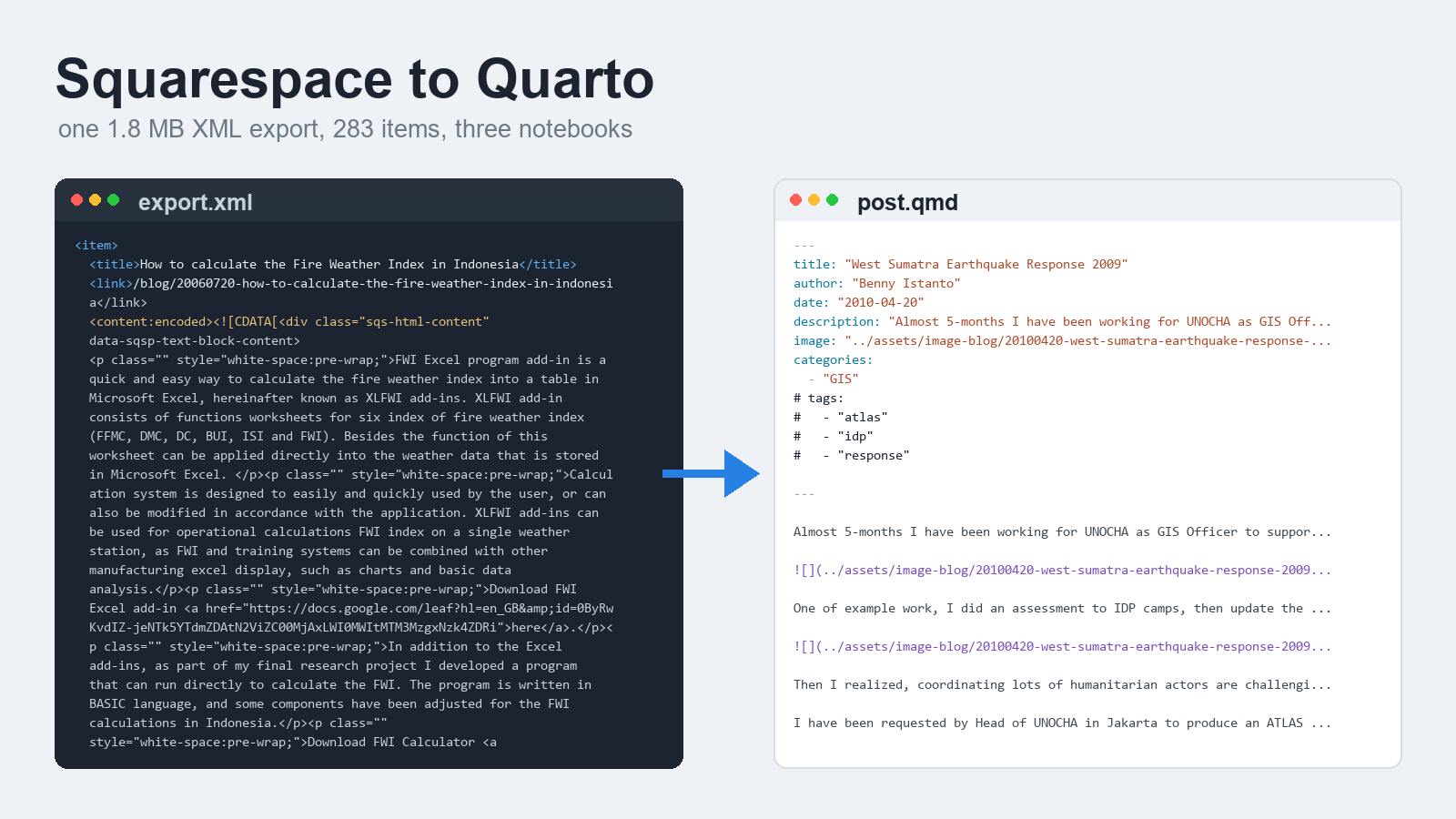
What survives:
- Blog posts, with title, body, tags and categories
- Pages, with title and body
- Text and basic formatting
- Image URLs, as references rather than files
- Publication dates and metadata
What does not:
- Custom CSS and JavaScript
- Gallery blocks, beyond the bare image list
- Custom blocks and third-party integrations
- Form submissions, commerce data, comments
- Audio and video blocks, though some embeds come through as links
- Site structure and navigation
The pattern is that anything Squarespace renders with its own JavaScript is gone, because there is nothing in the XML to render it from. Plan on rebuilding every gallery and every layout by hand.
The export lives under Settings, Advanced, Import/Export. Save the .xml somewhere you will not lose it, and keep the Squarespace site live until the new one is genuinely working.
The pipeline
Three steps, of which the third is optional.
Step 1: XML to Quarto markdown
The first notebook parses the export, pulls out posts and pages, converts the HTML bodies to markdown, and writes .qmd files with the frontmatter already filled in from the XML metadata. It keeps the page hierarchy if you ask it to, and it writes a manifest of every asset URL it saw, which the next step needs.
Set the paths at the top, then run it.
NotePython - configuration
# ---------- CONFIG ----------
INPUT_XML_FILE = r"C:\Users\benny\OneDrive\Documents\Github\site\downloads\Squarespace-Wordpress-Export-01-31-2026.xml"
OUTPUT_DIR     = r"C:\Users\benny\OneDrive\Documents\Github\site\temp4"   # or just "site" for relative
BASE_SITE_URL  = "https://benny.istan.to"  # used to resolve /s/... or /... links

PRESERVE_HIERARCHY = True     # nest pages by wp:post_parent
OVERWRITE          = False    # overwrite existing .qmd and manifest files
ALLOW_BLOG_PAGE_OVERWRITE = False  # if a PAGE slug == "blog", write to pages/blog/ instead of blog/index.qmd
NotePython - the converter
import os
import re
import csv
from datetime import datetime
from urllib.parse import urljoin

import xml.etree.ElementTree as ET
from bs4 import BeautifulSoup
from markdownify import markdownify as md

NAMESPACES = {
    "wp": "http://wordpress.org/export/1.2/",
    "content": "http://purl.org/rss/1.0/modules/content/",
    "excerpt": "http://wordpress.org/export/1.2/excerpt/",
    "dc": "http://purl.org/dc/elements/1.1/",
}

RAW_URL_RE = re.compile(r"https?://[^\s\"\'<>]+", re.IGNORECASE)


def get_text(element: ET.Element, tag: str, ns: dict | None = None) -> str:
    try:
        found = element.find(tag, namespaces=ns) if ns else element.find(tag)
        return (found.text or "").strip() if found is not None else ""
    except Exception:
        return ""


def parse_rfc822_to_iso(pub_date: str) -> str:
    if not pub_date:
        return ""
    try:
        dt_obj = datetime.strptime(pub_date, "%a, %d %b %Y %H:%M:%S %z")
        return dt_obj.strftime("%Y-%m-%d")
    except Exception:
        return ""


def yaml_escape(s: str) -> str:
    return (s or "").replace('"', "'").replace("\n", " ").strip()


def format_yaml(title: str, date_rfc822: str, categories: list[str], tags: list[str],
                author: str, summary: str = "") -> str:
    title = title or "Untitled"
    out = ["---", f'title: "{yaml_escape(title)}"']

    if author:
        out.append(f'author: "{yaml_escape(author)}"')

    date_iso = parse_rfc822_to_iso(date_rfc822)
    if date_iso:
        out.append(f'date: "{date_iso}"')

    merged = sorted({t for t in (categories or []) + (tags or []) if t})
    if merged:
        out.append("categories:")
        for t in merged:
            out.append(f'  - "{yaml_escape(t)}"')

    if summary:
        out.append(f'description: "{yaml_escape(summary)}"')

    out.append("---\n")
    return "\n".join(out)


def pick_best_from_srcset(srcset: str) -> str:
    if not srcset:
        return ""
    best_url, best_w = "", -1
    for part in srcset.split(","):
        part = part.strip()
        if not part:
            continue
        tokens = part.split()
        url = tokens[0].strip()
        w = 0
        if len(tokens) > 1 and tokens[1].lower().endswith("w"):
            try:
                w = int(tokens[1][:-1])
            except Exception:
                w = 0
        if w >= best_w:
            best_w = w
            best_url = url
    return best_url


def normalize_url(u: str, base_site_url: str) -> str:
    u = (u or "").strip()
    if not u:
        return ""
    if u.startswith("//"):
        u = "https:" + u
    if u.startswith("/"):
        u = urljoin(base_site_url.rstrip("/") + "/", u.lstrip("/"))
    return u


def normalize_media_attributes(soup: BeautifulSoup, base_site_url: str) -> None:
    # Images: promote real URL into src and drop srcset
    for img in soup.find_all("img"):
        cand = ""
        for attr in ("data-src", "data-image", "data-original"):
            if img.get(attr):
                cand = img.get(attr)
                break
        if not cand and img.get("srcset"):
            cand = pick_best_from_srcset(img.get("srcset"))
        if not cand and img.get("src"):
            cand = img.get("src")

        cand = normalize_url(cand, base_site_url)
        if cand:
            img["src"] = cand
        if img.get("srcset"):
            del img["srcset"]

    # Links
    for a in soup.find_all("a"):
        href = normalize_url(a.get("href", ""), base_site_url)
        if href:
            a["href"] = href

    # Other common media
    for tag_name, attr in [("source", "src"), ("video", "src"), ("audio", "src"), ("iframe", "src")]:
        for t in soup.find_all(tag_name):
            v = normalize_url(t.get(attr, ""), base_site_url)
            if v:
                t[attr] = v


def clean_content_to_markdown(html_content: str, base_site_url: str) -> str:
    if not html_content:
        return ""
    soup = BeautifulSoup(html_content, "lxml")

    # Unwrap common Squarespace wrappers
    for div in soup.find_all("div", class_="sqs-html-content"):
        div.unwrap()

    # Critical: normalize <img> / links BEFORE markdownify
    normalize_media_attributes(soup, base_site_url)

    markdown_text = md(str(soup), heading_style="ATX", bullets="-")
    markdown_text = re.sub(r"\n{3,}", "\n\n", markdown_text).strip()
    return markdown_text


def extract_asset_urls_from_raw_html(html_content: str, base_site_url: str) -> set[str]:
    urls: set[str] = set()
    if not html_content:
        return urls

    soup = BeautifulSoup(html_content, "lxml")

    attrs = ["src", "href", "data-src", "data-image", "data-original", "poster"]
    for tag in soup.find_all(True):
        for a in attrs:
            if tag.get(a):
                urls.add(normalize_url(tag.get(a), base_site_url))

    # srcset candidates
    for img in soup.find_all("img"):
        if img.get("srcset"):
            for part in img["srcset"].split(","):
                part = part.strip()
                if part:
                    urls.add(normalize_url(part.split()[0].strip(), base_site_url))

    # raw URL fallback
    for u in RAW_URL_RE.findall(html_content):
        urls.add(normalize_url(u, base_site_url))

    return {u for u in urls if u}


def write_blog_index(out_root: str, overwrite: bool = False) -> None:
    blog_dir = os.path.join(out_root, "blog")
    os.makedirs(blog_dir, exist_ok=True)
    path = os.path.join(blog_dir, "index.qmd")
    if os.path.exists(path) and not overwrite:
        return
    content = """---
title: "Blog"
listing:
  contents: .
  sort: "date desc"
  type: default
  categories: true
  page-size: 20
  exclude: "index.qmd"
---

Welcome to the blog.
"""
    with open(path, "w", encoding="utf-8", newline="\n") as f:
        f.write(content)


def build_pages_map(channel: ET.Element) -> dict[str, dict]:
    pages_map: dict[str, dict] = {}
    for item in channel.findall("item"):
        post_type = get_text(item, "wp:post_type", NAMESPACES)
        if post_type == "attachment":
            continue
        post_id = get_text(item, "wp:post_id", NAMESPACES)
        slug = get_text(item, "wp:post_name", NAMESPACES)
        parent_id = get_text(item, "wp:post_parent", NAMESPACES)
        if post_id:
            pages_map[post_id] = {"slug": slug, "parent_id": parent_id}
    return pages_map


def get_parent_slug_path(pages_map: dict[str, dict], parent_id: str) -> str:
    if not parent_id or parent_id == "0" or parent_id not in pages_map:
        return ""
    parent = pages_map[parent_id]
    grand = get_parent_slug_path(pages_map, parent["parent_id"])
    return os.path.join(grand, parent["slug"]) if grand else parent["slug"]


def convert_wxr_to_quarto(
    input_xml: str,
    out_root: str,
    base_site_url: str,
    preserve_hierarchy: bool = True,
    overwrite: bool = False,
    allow_blog_page_overwrite: bool = False
):
    if not os.path.exists(input_xml):
        raise FileNotFoundError(f"XML not found: {input_xml}")

    os.makedirs(out_root, exist_ok=True)

    manifest_txt = os.path.join(out_root, "_asset_manifest.txt")
    manifest_csv = os.path.join(out_root, "_asset_manifest.csv")

    if overwrite:
        for p in (manifest_txt, manifest_csv):
            if os.path.exists(p):
                os.remove(p)

    write_blog_index(out_root, overwrite=overwrite)

    tree = ET.parse(input_xml)
    root = tree.getroot()
    channel = root.find("channel")
    if channel is None:
        raise ValueError("Invalid WXR: missing <channel>")

    pages_map = build_pages_map(channel)

    all_assets: set[str] = set()
    manifest_rows: dict[str, list[str]] = {}  # url -> row
    count_written = 0

    for item in channel.findall("item"):
        post_type = get_text(item, "wp:post_type", NAMESPACES)
        status = get_text(item, "wp:status", NAMESPACES)

        if status != "publish":
            continue
        if post_type in {"attachment", "nav_menu_item"}:
            continue

        title = get_text(item, "title")
        post_name = get_text(item, "wp:post_name", NAMESPACES)
        post_id = get_text(item, "wp:post_id", NAMESPACES)
        parent_id = get_text(item, "wp:post_parent", NAMESPACES)
        pub_date = get_text(item, "pubDate")
        author = get_text(item, "dc:creator", NAMESPACES)
        excerpt = get_text(item, "excerpt:encoded", NAMESPACES)

        categories, tags = [], []
        for cat in item.findall("category"):
            domain = (cat.get("domain") or "").strip()
            txt = (cat.text or "").strip()
            if not txt:
                continue
            if domain == "category":
                categories.append(txt)
            elif domain == "post_tag":
                tags.append(txt)

        raw_html = get_text(item, "content:encoded", NAMESPACES)

        # ---- Asset manifest extraction ----
        asset_urls = extract_asset_urls_from_raw_html(raw_html, base_site_url)

        attach_url = get_text(item, "wp:attachment_url", NAMESPACES)
        if attach_url:
            asset_urls.add(normalize_url(attach_url, base_site_url))

        for u in asset_urls:
            if u and u not in manifest_rows:
                all_assets.add(u)
                manifest_rows[u] = [u, post_type, post_name or "", post_id or ""]

        # ---- HTML -> Markdown ----
        body_md = clean_content_to_markdown(raw_html, base_site_url)
        front = format_yaml(title, pub_date, categories, tags, author, excerpt)
        final_content = front + body_md + "\n"

        # ---- Output path ----
        filename = "index.qmd"

        if post_type == "post":
            target_dir = os.path.join(out_root, "blog")
            filename = f"{post_name}.qmd" if post_name else "untitled.qmd"
        else:
            if post_name == "home":
                target_dir = out_root
            elif post_name == "blog":
                target_dir = os.path.join(out_root, "blog") if allow_blog_page_overwrite else os.path.join(out_root, "pages", "blog")
            else:
                if preserve_hierarchy:
                    parent_path = get_parent_slug_path(pages_map, parent_id)
                    target_dir = os.path.join(out_root, parent_path, post_name) if parent_path else os.path.join(out_root, post_name)
                else:
                    target_dir = os.path.join(out_root, post_name)

        os.makedirs(target_dir, exist_ok=True)
        full_path = os.path.join(target_dir, filename)

        if (not overwrite) and os.path.exists(full_path):
            base, ext = os.path.splitext(full_path)
            i = 2
            while os.path.exists(f"{base}-{i}{ext}"):
                i += 1
            full_path = f"{base}-{i}{ext}"

        with open(full_path, "w", encoding="utf-8", newline="\n") as f:
            f.write(final_content)

        count_written += 1

    # ---- Write manifest files ----
    with open(manifest_txt, "w", encoding="utf-8", newline="\n") as f:
        for u in sorted(all_assets):
            f.write(u + "\n")

    with open(manifest_csv, "w", encoding="utf-8", newline="") as f:
        w = csv.writer(f)
        w.writerow(["url", "post_type", "slug", "post_id"])
        for u in sorted(manifest_rows.keys()):
            w.writerow(manifest_rows[u])

    print(f"Extraction complete! {count_written} QMD files created.")
    print(f"Asset manifest: {manifest_txt} ({len(all_assets)} unique URLs)")
    return count_written, len(all_assets)
NotePython - run it
count_qmd, count_assets = convert_wxr_to_quarto(
    input_xml=INPUT_XML_FILE,
    out_root=OUTPUT_DIR,
    base_site_url=BASE_SITE_URL,
    preserve_hierarchy=PRESERVE_HIERARCHY,
    overwrite=OVERWRITE,
    allow_blog_page_overwrite=ALLOW_BLOG_PAGE_OVERWRITE,
)

count_qmd, count_assets
Out the other end: one .qmd per post and per page, with the image references still pointing at Squarespace’s servers. Nothing is downloaded yet.
Step 2: download the assets
The second notebook walks the .qmd files, finds every Squarespace URL, downloads it, and rewrites the reference to a local path.
Expect losses here. Some URLs have moved, some assets were never public, and Squarespace will rate-limit you if you go too fast. The notebook logs what failed rather than stopping, so you get a list to work through by hand afterwards.
NotePython - configuration
import os

SITE_DIR = r"C:\Users\benny\OneDrive\Documents\Github\site\temp4"   # where your .qmd are
ASSETS_DIR = os.path.join(SITE_DIR, "assets")
MANIFEST_PATH = os.path.join(SITE_DIR, "_asset_manifest.txt")

BASE_SITE_URL = "https://benny.istan.to"  # for /s/... links if any
DELAY_SECONDS = 1.0
OVERWRITE_EXISTING = False  # if True, redownload even if file exists
NotePython - the downloader
import os, re, csv, time, html, mimetypes
from urllib.parse import urlparse, unquote, parse_qs, urljoin

import requests
from requests.adapters import HTTPAdapter
from urllib3.util.retry import Retry

HEADERS = {
    "User-Agent": (
        "Mozilla/5.0 (Windows NT 10.0; Win64; x64) "
        "AppleWebKit/537.36 (KHTML, like Gecko) Chrome/91.0.4472.124 Safari/537.36"
    )
}

# Domains that usually host actual files
ASSET_HOSTS = {
    "images.squarespace-cdn.com",
    "static1.squarespace.com",
    "images.squarespace.com",
    "static.squarespace.com",
}

# Your site domain CAN be kept, but only for /s/ file URLs
SITE_HOST_ALLOW = {"benny.istan.to", "bennyistanto.squarespace.com"}

DOWNLOADABLE_EXTS = {
    ".jpg", ".jpeg", ".png", ".gif", ".webp", ".svg",
    ".pdf", ".zip", ".mp4", ".mov", ".mp3", ".wav",
    ".doc", ".docx", ".ppt", ".pptx", ".xls", ".xlsx",
}

FENCED_CODE_RE = re.compile(r"```.*?```", re.DOTALL)
MD_LINK_RE = re.compile(r"!\[[^\]]*\]\(([^)]+)\)|\[[^\]]*\]\(([^)]+)\)")
HTML_ATTR_RE = re.compile(r"""(?:src|href|data-src|data-image|data-original|poster)\s*=\s*["']([^"']+)["']""", re.IGNORECASE)
SRCSET_RE = re.compile(r"""srcset\s*=\s*["']([^"']+)["']""", re.IGNORECASE)
CSS_URL_RE = re.compile(r"""url\(\s*['"]?([^'")]+)['"]?\s*\)""", re.IGNORECASE)
RAW_URL_RE = re.compile(r"""https?://[^\s"'<>()]+""", re.IGNORECASE)

ASSET_ID_RE = re.compile(r"(\d{13}-[A-Z0-9]{8,})")


def create_session():
    s = requests.Session()
    s.headers.update(HEADERS)
    retry = Retry(
        total=6,
        backoff_factor=1,
        status_forcelist=[429, 500, 502, 503, 504],
        allowed_methods=["HEAD", "GET", "OPTIONS"],
    )
    adapter = HTTPAdapter(max_retries=retry)
    s.mount("https://", adapter)
    s.mount("http://", adapter)
    return s


def strip_trailing_punct(u: str) -> str:
    return u.rstrip(').,;:\'"!?]>')

def normalize_url(u: str, base_site_url: str) -> str:
    u = (u or "").strip().strip("<>")
    u = html.unescape(u)
    u = strip_trailing_punct(u)
    if u.startswith("//"):
        u = "https:" + u
    if u.startswith("/"):
        u = urljoin(base_site_url.rstrip("/") + "/", u.lstrip("/"))
    return u


def looks_like_downloadable_file(u: str) -> bool:
    """
    True if URL is likely a file asset (not a page).
    """
    try:
        p = urlparse(u)
        host = p.netloc.lower()
        path = p.path or ""
        ext = os.path.splitext(path)[1].lower()

        # 1) Asset CDN hosts: require a file extension OR content-type query
        if host in ASSET_HOSTS:
            if ext in DOWNLOADABLE_EXTS:
                return True
            q = parse_qs(p.query)
            if "content-type" in q:
                return True
            return False

        # 2) Your own domain: only download if it's a Squarespace file link (/s/...) AND looks like a file
        if host in SITE_HOST_ALLOW:
            if path.startswith("/s/") and (ext in DOWNLOADABLE_EXTS or ext):
                return True
            return False

        return False
    except Exception:
        return False


def asset_key(u: str) -> str:
    p = urlparse(u)
    return f"{p.netloc.lower()}{p.path}"


def best_quality_score(u: str, width_hint: int = 0) -> int:
    score = width_hint or 0
    try:
        q = parse_qs(urlparse(u).query)
        fmt = (q.get("format", [""])[0] or "").lower()
        m = re.search(r"(\d{3,5})w", fmt)
        if m:
            score = max(score, int(m.group(1)))
        if fmt in {"original", "raw"}:
            score = max(score, 99999)
    except Exception:
        pass
    return score


def safe_filename(name: str) -> str:
    name = unquote(name).replace(" ", "_")
    name = re.sub(r"[^A-Za-z0-9._-]+", "", name)
    name = re.sub(r"_{2,}", "_", name).strip("._-")
    return name or "asset"


def fix_extension(ext: str) -> str:
    if not ext:
        return ".jpg"
    ext = ext.lower()
    if ext in [".jpe", ".jpeg"]:
        return ".jpg"
    return ext


def choose_base_name(final_url: str) -> str:
    p = urlparse(final_url)
    m = ASSET_ID_RE.search(p.path or "")
    if m:
        return m.group(1)
    base = os.path.basename(p.path) or "asset"
    stem = os.path.splitext(base)[0] or "asset"
    return safe_filename(stem)


def extract_urls_from_text(text: str, base_site_url: str):
    text = FENCED_CODE_RE.sub("", text or "")
    found = []

    # Markdown links/images
    for m in MD_LINK_RE.findall(text):
        for raw in m:
            if raw:
                raw = raw.strip().strip('"').strip("'")
                norm = normalize_url(raw, base_site_url)
                found.append((raw, norm, 0))

    # HTML attributes
    for raw in HTML_ATTR_RE.findall(text):
        raw = raw.strip()
        norm = normalize_url(raw, base_site_url)
        found.append((raw, norm, 0))

    # srcset
    for srcset in SRCSET_RE.findall(text):
        parts = [p.strip() for p in srcset.split(",") if p.strip()]
        for part in parts:
            tokens = part.split()
            raw = tokens[0].strip()
            width_hint = 0
            if len(tokens) > 1:
                m = re.match(r"(\d{2,5})w", tokens[1].lower())
                if m:
                    width_hint = int(m.group(1))
            norm = normalize_url(raw, base_site_url)
            found.append((raw, norm, width_hint))

    # CSS url(...)
    for raw in CSS_URL_RE.findall(text):
        raw = raw.strip()
        norm = normalize_url(raw, base_site_url)
        found.append((raw, norm, 0))

    # Raw URLs
    for raw in RAW_URL_RE.findall(text):
        raw = raw.strip()
        norm = normalize_url(raw, base_site_url)
        found.append((raw, norm, 0))

    # Keep only downloadables
    out = []
    for raw, norm, w in found:
        if norm and looks_like_downloadable_file(norm):
            out.append((raw, norm, w))
    return out


def collect_qmd_files(site_dir: str, assets_dir: str):
    qmds = []
    for root, _, files in os.walk(site_dir):
        # skip the assets dir itself
        if os.path.abspath(root).startswith(os.path.abspath(assets_dir)):
            continue
        for fn in files:
            if fn.endswith(".qmd"):
                qmds.append(os.path.join(root, fn))
    qmds.sort()
    return qmds


def download_one(session, url, assets_path, delay_seconds: float, overwrite: bool):
    try:
        r = session.get(url, stream=True, allow_redirects=True, timeout=45)
        if r.status_code != 200:
            return False, None, r.url, f"HTTP {r.status_code}"

        ctype = (r.headers.get("content-type") or "").split(";")[0].strip().lower()
        if ctype.startswith("text/html"):
            return False, None, r.url, "Got HTML (page/blocked/redirected)"

        ext = os.path.splitext(urlparse(r.url).path)[1]
        if not ext:
            ext = mimetypes.guess_extension(ctype) or ""
        ext = fix_extension(ext)

        base = choose_base_name(r.url)
        filename_asset = f"{base}{ext}"
        save_path = os.path.join(assets_path, filename_asset)

        if os.path.exists(save_path) and not overwrite:
            return True, filename_asset, r.url, None

        uniq = 1
        final_name = filename_asset
        while os.path.exists(save_path) and overwrite is False:
            final_name = f"{base}_{uniq}{ext}"
            save_path = os.path.join(assets_path, final_name)
            uniq += 1

        with open(save_path, "wb") as f_out:
            for chunk in r.iter_content(chunk_size=1024 * 64):
                if chunk:
                    f_out.write(chunk)

        time.sleep(delay_seconds)
        return True, final_name, r.url, None

    except Exception as e:
        return False, None, url, str(e)


def run_download(site_dir, assets_dir, manifest_path, base_site_url, delay_seconds=1.0, overwrite=False):
    print(f"--- STARTING SCAN in: {site_dir} ---")
    os.makedirs(assets_dir, exist_ok=True)

    session = create_session()
    qmd_files = collect_qmd_files(site_dir, assets_dir)
    print(f"Found {len(qmd_files)} .qmd files.")

    # key -> (best_url, score)
    best = {}

    # QMD scan
    qmd_count = 0
    for fp in qmd_files:
        with open(fp, "r", encoding="utf-8") as f:
            text = f.read()
        triples = extract_urls_from_text(text, base_site_url)
        for _raw, norm, w in triples:
            k = asset_key(norm)
            score = best_quality_score(norm, w)
            prev = best.get(k)
            if prev is None or score > prev[1]:
                best[k] = (norm, score)
        qmd_count += len(triples)

    print(f"QMD scan: {len(best)} unique downloadable assets (from {qmd_count} URL hits).")

    # Manifest scan
    if manifest_path and os.path.exists(manifest_path):
        before = len(best)
        with open(manifest_path, "r", encoding="utf-8") as f:
            for line in f:
                u = normalize_url(line.strip(), base_site_url)
                if u and looks_like_downloadable_file(u):
                    k = asset_key(u)
                    score = best_quality_score(u, 0)
                    prev = best.get(k)
                    if prev is None or score > prev[1]:
                        best[k] = (u, score)
        after = len(best)
        print(f"Manifest added: {before} -> {after} unique downloadable assets.")
    else:
        print("Manifest not found / not used (this is why you only saw ~1013 previously).")

    keys = list(best.keys())
    print(f"Downloading {len(keys)} unique assets...")

    success_csv = os.path.join(assets_dir, "_download_success.csv")
    failed_txt = os.path.join(assets_dir, "_download_failed.txt")
    url_map = {}
    success_rows = []
    failed = []

    for i, k in enumerate(keys, 1):
        url = best[k][0]
        ok, local_name, final_url, err = download_one(session, url, assets_dir, delay_seconds, overwrite)
        if ok:
            url_map[k] = local_name
            success_rows.append([k, url, final_url, local_name])
            if i <= 20 or i % 200 == 0:
                print(f"[{i}/{len(keys)}] OK  -> {local_name}")
        else:
            failed.append(f"{url}\t{err}")
            if i <= 20 or i % 200 == 0:
                print(f"[{i}/{len(keys)}] FAIL -> {url} ({err})")

    with open(success_csv, "w", newline="", encoding="utf-8") as f:
        w = csv.writer(f)
        w.writerow(["asset_key", "requested_url", "final_url", "local_filename"])
        w.writerows(success_rows)

    if failed:
        with open(failed_txt, "w", encoding="utf-8") as f:
            f.write("\n".join(failed) + "\n")

    # Rewrite QMD links
    changed_files = 0
    for fp in qmd_files:
        with open(fp, "r", encoding="utf-8") as f:
            text = f.read()

        triples = extract_urls_from_text(text, base_site_url)
        if not triples:
            continue

        qmd_dir = os.path.dirname(fp)
        rel_assets = os.path.relpath(assets_dir, qmd_dir).replace("\\", "/")

        new_text = text
        changed = False
        for raw, norm, _w in triples:
            k = asset_key(norm)
            if k in url_map:
                local_rel = f"{rel_assets}/{url_map[k]}".replace("\\", "/")
                if raw in new_text:
                    new_text = new_text.replace(raw, local_rel)
                    changed = True

        if changed and new_text != text:
            with open(fp, "w", encoding="utf-8", newline="\n") as f:
                f.write(new_text)
            changed_files += 1

    print("\nDone.")
    print(f"- Downloaded: {len(url_map)}")
    print(f"- Failed: {len(failed)} (see {failed_txt})" if failed else "- Failed: 0")
    print(f"- Updated QMD files: {changed_files}")
    print(f"- Logs: {success_csv}")
NotePython - run it
run_download(
    site_dir=SITE_DIR,
    assets_dir=ASSETS_DIR,
    manifest_path=MANIFEST_PATH,
    base_site_url=BASE_SITE_URL,
    delay_seconds=DELAY_SECONDS,
    overwrite=OVERWRITE_EXISTING
)
Step 3: rename the assets, if you need to
Skip this one if your Squarespace filenames are already sane. Mine were not: years of uploads had left me with images called things like image-asset.jpeg and a lot of hex strings, with no way to tell which post an image belonged to.
This notebook works out which post uses which asset, renames each one after the post plus a sequence number, and updates the references to match. A post called 2025-blog-helloworld.qmd ends up with 2025-blog-helloworld-01.png, -02.png and so on.
The useful side effect is that anything it does not rename is an asset no post references, which is how you find the orphans.
It has a DRY_RUN flag. Use it.
NotePython - configuration
import os

ROOT_DIR = r"C:\Users\benny\OneDrive\Documents\Github\site\temp4"  # your site folder containing .qmd + assets/
ASSETS_DIR = os.path.join(ROOT_DIR, "assets")

DRY_RUN = True   # <-- set to False to actually rename + write QMD updates
NotePython - the renamer
import os
import re
import csv
from collections import defaultdict
from urllib.parse import unquote

# Matches markdown links/images: (...assets/anything...)
MD_ASSET_LINK_RE = re.compile(r'\(([^)\n]*assets/[^)\n]+)\)')
# Matches HTML attributes: src="...assets/..." or href="...assets/..."
HTML_ASSET_ATTR_RE = re.compile(r'''(?:src|href)\s*=\s*["']([^"']*assets/[^"']+)["']''', re.IGNORECASE)

def extract_asset_links(text: str):
    """Return unique asset link strings found in QMD text (preserve first-seen order)."""
    links = []
    for m in MD_ASSET_LINK_RE.finditer(text or ""):
        links.append(m.group(1))
    for m in HTML_ASSET_ATTR_RE.finditer(text or ""):
        links.append(m.group(1))

    seen = set()
    out = []
    for x in links:
        if x not in seen:
            seen.add(x)
            out.append(x)
    return out

def find_file_on_disk(qmd_dir: str, link_path: str):
    """
    link_path like "../assets/file(1).png?format=1500w" or "assets/x.png"
    Returns absolute path if exists, else None
    """
    clean = link_path.split("?")[0]  # drop query
    candidates = [
        os.path.normpath(os.path.join(qmd_dir, clean)),                            # literal
        os.path.normpath(os.path.join(qmd_dir, unquote(clean))),                   # url-decoded
        os.path.normpath(os.path.join(qmd_dir, clean.replace("+", " "))),          # plus->space
        os.path.normpath(os.path.join(qmd_dir, unquote(clean).replace("+", " "))), # both
    ]
    for p in candidates:
        if os.path.exists(p) and os.path.isfile(p):
            return p
    return None

def relink_same_prefix(original_link: str, new_filename: str) -> str:
    """
    Keep the original link's path prefix (e.g., ../assets/) but replace the filename.
    Also removes query params.
    """
    clean = original_link.split("?")[0]
    prefix = clean.rsplit("/", 1)[0]  # everything before filename
    return f"{prefix}/{new_filename}"

def safe_new_name(base_stem: str, idx: int, ext: str) -> str:
    ext = ext if ext else ".jpg"
    return f"{base_stem}-{idx:02d}{ext}"

def rename_assets_rename_only(root_dir: str, assets_dir: str, dry_run: bool = True):
    if not os.path.isdir(assets_dir):
        raise FileNotFoundError(f"Assets dir not found: {assets_dir}")

    # Collect QMD files
    qmd_files = []
    for r, _, files in os.walk(root_dir):
        if os.path.abspath(r).startswith(os.path.abspath(assets_dir)):
            continue
        for fn in files:
            if fn.endswith(".qmd"):
                qmd_files.append(os.path.join(r, fn))
    qmd_files.sort()  # deterministic order

    print(f"Found {len(qmd_files)} QMD files")

    # 1) Build reference map: abs_asset_path -> list of (qmd_path, original_link, position)
    refs = defaultdict(list)

    # Also store per QMD the links in order for canonical indexing
    qmd_link_order = {}

    for qmd_path in qmd_files:
        qmd_dir = os.path.dirname(qmd_path)
        with open(qmd_path, "r", encoding="utf-8") as f:
            text = f.read()

        links = extract_asset_links(text)
        qmd_link_order[qmd_path] = links

        for pos, link in enumerate(links, start=1):
            abs_path = find_file_on_disk(qmd_dir, link)
            if abs_path:
                refs[abs_path].append((qmd_path, link, pos))

    print(f"Referenced unique asset files: {len(refs)}")

    # 2) Decide canonical name per asset (rename-only):
    #    Choose canonical QMD = first QMD (sorted) that references the asset.
    #    Choose index based on first appearance order in that canonical QMD.
    #    If collisions occur, bump index until free.
    asset_plan = {}  # abs_asset_path -> dict(new_name, canonical_qmd, ref_count)

    # Track counters per canonical QMD for naming
    # BUT: we must ensure stable per-asset index = first appearance in canonical QMD,
    # then collision bump if needed.
    for abs_asset_path, occurrences in refs.items():
        occurrences_sorted = sorted(occurrences, key=lambda x: (x[0], x[2]))  # by qmd_path then position
        canonical_qmd, _link, pos = occurrences_sorted[0]
        stem = os.path.splitext(os.path.basename(canonical_qmd))[0]
        ext = os.path.splitext(abs_asset_path)[1] or os.path.splitext(_link.split("?")[0])[1] or ".jpg"

        # base index = pos in canonical qmd order (so it "follows qmd filename" naturally)
        idx = pos

        new_name = safe_new_name(stem, idx, ext)
        new_abs = os.path.join(assets_dir, new_name)

        # collision resolution
        bump = idx
        while os.path.exists(new_abs) and os.path.normpath(new_abs) != os.path.normpath(abs_asset_path):
            bump += 1
            new_name = safe_new_name(stem, bump, ext)
            new_abs = os.path.join(assets_dir, new_name)

        asset_plan[abs_asset_path] = {
            "canonical_qmd": canonical_qmd,
            "ref_count": len(occurrences),
            "new_name": new_name,
            "new_abs": new_abs,
        }

    shared_assets = [p for p, info in asset_plan.items() if info["ref_count"] > 1]
    print(f"Shared assets (used by >1 QMD): {len(shared_assets)}")
    print(f"DRY_RUN={dry_run}")

    # 3) Apply renames (each asset once)
    rename_map = {}  # old_abs -> new_abs
    for old_abs, info in asset_plan.items():
        new_abs = info["new_abs"]
        if os.path.normpath(old_abs) == os.path.normpath(new_abs):
            continue  # already in desired name
        rename_map[old_abs] = new_abs

    # 4) Update QMD contents based on rename_map
    updated_files = 0
    total_replacements = 0

    # pre-read all QMD to memory to avoid multiple disk writes
    qmd_text = {}
    for qmd_path in qmd_files:
        with open(qmd_path, "r", encoding="utf-8") as f:
            qmd_text[qmd_path] = f.read()

    # create helper: old filename -> new filename (because QMD links are relative)
    oldfile_to_newfile = {}
    for old_abs, new_abs in rename_map.items():
        oldfile_to_newfile[os.path.basename(old_abs)] = os.path.basename(new_abs)

    # update links
    for qmd_path in qmd_files:
        text = qmd_text[qmd_path]
        links = extract_asset_links(text)
        if not links:
            continue

        new_text = text
        changed = False
        for link in links:
            clean = link.split("?")[0]
            filename = clean.rsplit("/", 1)[-1]
            if filename in oldfile_to_newfile:
                new_link = relink_same_prefix(link, oldfile_to_newfile[filename])
                if link in new_text:
                    new_text = new_text.replace(link, new_link)
                    total_replacements += 1
                    changed = True
                elif clean in new_text:
                    new_text = new_text.replace(clean, new_link)
                    total_replacements += 1
                    changed = True

        if changed and new_text != text:
            qmd_text[qmd_path] = new_text
            updated_files += 1

    # 5) Write logs
    rename_csv = os.path.join(assets_dir, "_rename_map.csv")
    shared_csv = os.path.join(assets_dir, "_shared_assets.csv")

    rows = []
    shared_rows = []
    for old_abs, info in asset_plan.items():
        old_name = os.path.basename(old_abs)
        new_name = os.path.basename(info["new_abs"])
        row = [
            old_name,
            new_name,
            os.path.relpath(info["canonical_qmd"], root_dir).replace("\\", "/"),
            info["ref_count"],
        ]
        rows.append(row)
        if info["ref_count"] > 1:
            shared_rows.append(row)

    if not dry_run:
        # apply filesystem renames
        for old_abs, new_abs in rename_map.items():
            os.rename(old_abs, new_abs)

        # write updated QMDs
        for qmd_path, text in qmd_text.items():
            with open(qmd_path, "w", encoding="utf-8", newline="\n") as f:
                f.write(text)

        # write csv logs
        with open(rename_csv, "w", newline="", encoding="utf-8") as f:
            w = csv.writer(f)
            w.writerow(["old_filename", "new_filename", "canonical_qmd", "ref_count"])
            w.writerows(rows)

        with open(shared_csv, "w", newline="", encoding="utf-8") as f:
            w = csv.writer(f)
            w.writerow(["old_filename", "new_filename", "canonical_qmd", "ref_count"])
            w.writerows(shared_rows)

    print("\n--- SUMMARY ---")
    print(f"Planned renames: {len(rename_map)}")
    print(f"QMD files to update: {updated_files}")
    print(f"Total link replacements: {total_replacements}")
    print(f"Rename log (will be written when DRY_RUN=False): {rename_csv}")
    print(f"Shared assets report (will be written when DRY_RUN=False): {shared_csv}")

    # return some quick stats for notebook inspection
    return {
        "qmd_files": len(qmd_files),
        "unique_assets_referenced": len(refs),
        "shared_assets": len(shared_assets),
        "planned_renames": len(rename_map),
        "qmd_files_to_update": updated_files,
        "total_replacements": total_replacements,
    }
NotePython - run it
DRY_RUN = False
stats = rename_assets_rename_only(ROOT_DIR, ASSETS_DIR, dry_run=DRY_RUN)
stats
The equations
One thing the export does not warn you about: if you wrote equations in Squarespace, they come back as images. Not markup, pictures of maths. They do not scale, they do not respond to dark mode, they are invisible to search and to screen readers, and on a phone they overflow the column.
I had enough of these across the older posts that fixing them by hand was not sensible, so they got their own scripts: one general pass, one for the radiation posts, which had a house style of their own, and one for the stragglers. They rewrite the image references as real LaTeX that MathJax renders.
NotePython - convert_equations.py
#!/usr/bin/env python3
# -*- coding: utf-8 -*-
"""
Convert mathematical equations to LaTeX format in blog posts
"""

import re
import os

def convert_file(filepath):
    """Convert equations in a single file"""
    with open(filepath, 'r', encoding='utf-8') as f:
        content = f.read()

    original_content = content

    # File-specific conversions based on filename
    filename = os.path.basename(filepath)

    if filename == '20031028-pengukuran-suhu.qmd':
        # Equation 4.2
        content = content.replace(
            'RT = Ro[1+ a (T-To)] ……………….(4.2)',
            r'$$R_T = R_o[1+ a (T-T_o)] \tag{4.2}$$'
        )
        content = re.sub(
            r'dimana \(t-To\) kecil',
            r'dimana $(t-T_o)$ kecil',
            content
        )
        content = re.sub(
            r'RT adalah hambatan',
            r'$R_T$ adalah hambatan',
            content
        )
        content = re.sub(
            r'Ro adalah koefisin suhu referensi To',
            r'$R_o$ adalah koefisin suhu referensi $T_o$',
            content
        )
        content = re.sub(
            r'a adalah koefisien suhu dari hambatan disekitar To',
            r'$a$ adalah koefisien suhu dari hambatan disekitar $T_o$',
            content
        )
        # Equation 4.3
        content = content.replace(
            'RT = Ro [1 + a (t-To) + b (T-To)2] ….(4.3)',
            r'$$R_T = R_o [1 + a (t-T_o) + b (T-T_o)^2] \tag{4.3}$$'
        )
        content = re.sub(
            r'Jadi nilai koefisien a dan b dapat',
            r'Jadi nilai koefisien $a$ dan $b$ dapat',
            content
        )
        # Equation 4.4
        content = content.replace(
            'R = a exp (b/T)',
            r'$$R = a \exp(b/T) \tag{4.4}$$'
        )
        content = re.sub(
            r'dimana a dan b adalah konstan dan T adalah suhu',
            r'dimana $a$ dan $b$ adalah konstan dan $T$ adalah suhu',
            content
        )
        # Equation 4.5
        content = re.sub(
            r'R = Ro exp \[b/T-b/To\] ……………\.\(4\.5\)',
            r'$$R = R_o \exp\left[\\frac{b}{T}-\\frac{b}{T_o}\right] \\tag{4.5}$$',
            content
        )
        content = re.sub(
            r'suhu referensi, To digunakan',
            r'suhu referensi, $T_o$ digunakan',
            content
        )

    elif filename == '20040103-menghitung-radiasi-matahari.qmd':
        # Equation 1
        content = re.sub(
            r'Ra = \(24\(60\)\)/π \\\* Gsc \\\* dr \\\* \[ωs \\\* sin\(φ\) \\\* sin\(δ\) \+ cos\(φ\) \\\* cos\(δ\) \\\* sin\(ωs\)\] \(\*\*Persamaan 1\*\*\)',
            r'$$R_a = \\frac{24(60)}{\\pi} G_{sc} d_r [\\omega_s \\sin(\\phi) \\sin(\\delta) + \\cos(\\phi) \\cos(\\delta) \\sin(\\omega_s)] \\tag{1}$$',
            content
        )
        # Equation 2
        content = re.sub(
            r'evaporasi \[mm hari-1\] = 0,408 x Radiasi \[MJ m-2 hari-1\] \(\*\*Persamaan 2\*\*\)',
            r'$$\\text{evaporasi [mm hari}^{-1}\\text{]} = 0.408 \\times \\text{Radiasi [MJ m}^{-2}\\text{ hari}^{-1}\\text{]} \\tag{2}$$',
            content
        )
        # Equation 3
        content = re.sub(
            r'\[Radians\] = π/180 \\\* \[decimal degrees\] \(\*\*Persamaan 3\*\*\)',
            r'$$[\\text{Radians}] = \\frac{\\pi}{180} \\times [\\text{decimal degrees}] \\tag{3}$$',
            content
        )
        # Equation 4
        content = re.sub(
            r'dr = 1 \+ 0\.033 \\\* cos\(2π/365 \\\* J\) \(\*\*Persamaan 4\*\*\)',
            r'$$d_r = 1 + 0.033 \\cos\\left(\\frac{2\\pi}{365} J\\right) \\tag{4}$$',
            content
        )
        # Equation 5
        content = re.sub(
            r'δ = 0\.409 \\\* sin\(2π/365 \\\* J - 1\.39\) \(\*\*Persamaan 5\*\*\)',
            r'$$\\delta = 0.409 \\sin\\left(\\frac{2\\pi}{365} J - 1.39\\right) \\tag{5}$$',
            content
        )

    # Only write if content changed
    if content != original_content:
        with open(filepath, 'w', encoding='utf-8') as f:
            f.write(content)
        return True
    return False

# Main execution
if __name__ == '__main__':
    blog_dir = r'C:\Users\benny\OneDrive\Documents\Github\site\docs\blog'

    files_to_convert = [
        '20031028-pengukuran-suhu.qmd',
        '20040103-menghitung-radiasi-matahari.qmd',
    ]

    for filename in files_to_convert:
        filepath = os.path.join(blog_dir, filename)
        if os.path.exists(filepath):
            if convert_file(filepath):
                print(f'Converted: {filename}')
            else:
                print(f'No changes: {filename}')
        else:
            print(f'File not found: {filename}')
NotePython - convert_radiation_equations.py
#!/usr/bin/env python3
# -*- coding: utf-8 -*-
"""
Convert mathematical equations to LaTeX format in radiation blog post
"""

import re

def convert_radiation_file():
    """Convert equations in 20040103-menghitung-radiasi-matahari.qmd"""
    filepath = r'C:\Users\benny\OneDrive\Documents\Github\site\docs\blog\20040103-menghitung-radiasi-matahari.qmd'

    with open(filepath, 'r', encoding='utf-8') as f:
        content = f.read()

    # Store original for comparison
    original_content = content

    # Equation 1
    content = re.sub(
        r'Ra = \(24\(60\)\)/π \\\* Gsc \\\* dr \\\* \[ωs \\\* sin\(φ\) \\\* sin\(δ\) \+ cos\(φ\) \\\* cos\(δ\) \\\* sin\(ωs\)\] \(\*\*Persamaan 1\*\*\)',
        r'$$R_a = \\frac{24(60)}{\\pi} G_{sc} d_r [\\omega_s \\sin(\\phi) \\sin(\\delta) + \\cos(\\phi) \\cos(\\delta) \\sin(\\omega_s)] \\tag{1}$$',
        content
    )

    # Equation 2
    content = re.sub(
        r'evaporasi \[mm hari-1\] = 0,408 x Radiasi \[MJ m-2 hari-1\] \(\*\*Persamaan 2\*\*\)',
        r'$$\\text{evaporasi [mm hari}^{-1}\\text{]} = 0.408 \\times \\text{Radiasi [MJ m}^{-2}\\text{ hari}^{-1}\\text{]} \\tag{2}$$',
        content
    )

    # Equation 3
    content = re.sub(
        r'\[Radians\] = π/180 \\\* \[decimal degrees\] \(\*\*Persamaan 3\*\*\)',
        r'$$[\\text{Radians}] = \\frac{\\pi}{180} \\times [\\text{decimal degrees}] \\tag{3}$$',
        content
    )

    # Equation 4
    content = re.sub(
        r'dr = 1 \+ 0\.033 \\\* cos\(2π/365 \\\* J\) \(\*\*Persamaan 4\*\*\)',
        r'$$d_r = 1 + 0.033 \\cos\\left(\\frac{2\\pi}{365} J\\right) \\tag{4}$$',
        content
    )

    # Equation 5
    content = re.sub(
        r'δ = 0\.409 \\\* sin\(2π/365 \\\* J - 1\.39\) \(\*\*Persamaan 5\*\*\)',
        r'$$\\delta = 0.409 \\sin\\left(\\frac{2\\pi}{365} J - 1.39\\right) \\tag{5}$$',
        content
    )

    # Equation 6 (multi-line)
    content = re.sub(
        r'J = INTEGER \(275 M / 9 - 30 \+ D\) - 2\n\nIF \(M <3\) THEN J = J \+ 2\n\nIF \("tahun kabisat" and \(M> 2\)\) THEN J = J \+ 1 \(\*\*Persamaan 6\*\*\)',
        r'$$J = \\text{INTEGER}\\left(\\frac{275M}{9} - 30 + D\\right) - 2$$\n\n$$\\text{IF } (M < 3) \\text{ THEN } J = J + 2$$\n\n$$\\text{IF ("tahun kabisat" and } (M > 2)) \\text{ THEN } J = J + 1 \\tag{6}$$',
        content
    )

    # Equation 7
    content = re.sub(
        r'ωs = arccos\[-tan\(φ\) \\\* tan\(δ\)\] \(\*\*Persamaan 7\*\*\)',
        r'$$\\omega_s = \\arccos[-\\tan(\\phi) \\tan(\\delta)] \\tag{7}$$',
        content
    )

    # Equation 8
    content = re.sub(
        r'ωs = π/2 - arctan\[\(-tan\(φ\) \\\* tan\(δ\)\)/X\^0\.5\] \(\*\*Persamaan 8\*\*\)',
        r'$$\\omega_s = \\frac{\\pi}{2} - \\arctan\\left[\\frac{-\\tan(\\phi) \\tan(\\delta)}{X^{0.5}}\\right] \\tag{8}$$',
        content
    )

    # Equation 9
    content = re.sub(
        r'\* X = 1 - \[tan\(φ\)\]\^2 \[tan\(δ\)\]\^2 \(\*\*Persamaan 9\*\*\)\n\n  dan X = 0\.00001 jika X ≤ 0',
        r'$$X = 1 - [\\tan(\\phi)]^2 [\\tan(\\delta)]^2 \\tag{9}$$\n\n  dan $X = 0.00001$ jika $X \\leq 0$',
        content
    )

    # Equation 10
    content = re.sub(
        r'Ra = \(12\(60\)\)/π \\\* Gsc \\\* dr \\\* \[\(ω2 - ω1\) \\\* sin\(φ\) \\\* sin\(δ\) \+ cos\(φ\) \\\* cos\(δ\) \\\* \(sin\(ω2\)-sin\(ω1\)\)\] \(\*\*Persamaan 10\*\*\)',
        r'$$R_a = \\frac{12(60)}{\\pi} G_{sc} d_r [(\\omega_2 - \\omega_1) \\sin(\\phi) \\sin(\\delta) + \\cos(\\phi) \\cos(\\delta) (\\sin(\\omega_2)-\\sin(\\omega_1))] \\tag{10}$$',
        content
    )

    # Equations 11 and 12
    content = re.sub(
        r'ω1 = ω - \(πt1/24\) \(\*\*Persamaan 11\*\*\)\n\nω2 = ω \+ \(πt1/24\) \(\*\*Persamaan 12\*\*\)',
        r'$$\\omega_1 = \\omega - \\frac{\\pi t_1}{24} \\tag{11}$$\n\n$$\\omega_2 = \\omega + \\frac{\\pi t_1}{24} \\tag{12}$$',
        content
    )

    # Equation 13
    content = re.sub(
        r'ω = π/12 \\\* \[\(t \+ 0\.06667 \\\* \(Lz - Lm\) \+ Sc\) - 12\] \(\*\*Persamaan 13\*\*\)',
        r'$$\\omega = \\frac{\\pi}{12} [(t + 0.06667 (L_z - L_m) + S_c) - 12] \\tag{13}$$',
        content
    )

    # Equation 14
    content = re.sub(
        r'Sc = 0\.1645 \\\* sin\(2 b\) - 0\.1255 \\\* cos\(b\) - 0\.025 sin\(b\) \(\*\*Persamaan 14\*\*\)',
        r'$$S_c = 0.1645 \\sin(2b) - 0.1255 \\cos(b) - 0.025 \\sin(b) \\tag{14}$$',
        content
    )

    # Equation 15
    content = re.sub(
        r'b = \(2π\(J-81\)\)/364 \(\*\*Persamaan 15\*\*\)',
        r'$$b = \\frac{2\\pi(J-81)}{364} \\tag{15}$$',
        content
    )

    # Equation 16
    content = re.sub(
        r'N = 24/π \\\* ωs \(\*\*Persamaan 16\*\*\)',
        r'$$N = \\frac{24}{\\pi} \\omega_s \\tag{16}$$',
        content
    )

    # Equation 17
    content = re.sub(
        r'Rs = \(as \+ bs \\\* \(n/N\)\) \\\* Ra \(\*\*Persamaan 17\*\*\)',
        r'$$R_s = (a_s + b_s \\frac{n}{N}) R_a \\tag{17}$$',
        content
    )

    # Equation 18
    content = re.sub(
        r'Rso = \(as \+ bs\) Ra \(\*\*Persamaan 18\*\*\)',
        r'$$R_{so} = (a_s + b_s) R_a \\tag{18}$$',
        content
    )

    # Equation 19
    content = re.sub(
        r'Rso = \(0,75 \+ 2E10-5z\) Ra \(\*\*Persamaan 19\*\*\)',
        r'$$R_{so} = (0.75 + 2 \\times 10^{-5}z) R_a \\tag{19}$$',
        content
    )

    # Equation 20
    content = re.sub(
        r'Rns = \(1-a\) Rs \(\*\*Persamaan 20\*\*\)',
        r'$$R_{ns} = (1-\\alpha) R_s \\tag{20}$$',
        content
    )

    # Equation 21 (complex)
    content = re.sub(
        r'Rnl = σ\[\(\(Tmax \+ 273\.16\)\^4 \+ \(Tmin \+ 273\.16\)\^4\) / 2\] \\\* \(0\.34 - 0\.14√ea\) \\\* \[1\.35 \\\* Rs/Rso - 0\.35\] \(\*\*Persamaan 21\*\*\)',
        r'$$R_{nl} = \\sigma\\left[\\frac{(T_{max} + 273.16)^4 + (T_{min} + 273.16)^4}{2}\\right] (0.34 - 0.14\\sqrt{e_a}) \\left[1.35 \\frac{R_s}{R_{so}} - 0.35\\right] \\tag{21}$$',
        content
    )

    # Equation 22
    content = re.sub(
        r'Rn = Rns - Rnl \(\*\*Persamaan 22\*\*\)',
        r'$$R_n = R_{ns} - R_{nl} \\tag{22}$$',
        content
    )

    # Only write if content changed
    if content != original_content:
        with open(filepath, 'w', encoding='utf-8') as f:
            f.write(content)
        print(f'Successfully converted equations in 20040103-menghitung-radiasi-matahari.qmd')
        return True
    else:
        print(f'No changes made to 20040103-menghitung-radiasi-matahari.qmd')
        return False

if __name__ == '__main__':
    convert_radiation_file()
NotePython - convert_remaining_equations.py
#!/usr/bin/env python3
# -*- coding: utf-8 -*-
"""
Convert remaining mathematical equations to LaTeX format
"""

import re
import sys

# Set UTF-8 encoding for stdout
if sys.platform == 'win32':
    import codecs
    sys.stdout = codecs.getwriter('utf-8')(sys.stdout.buffer, 'strict')

def convert_pengukuran_suhu():
    """Convert equations in 20031028-pengukuran-suhu.qmd"""
    filepath = r'C:\Users\benny\OneDrive\Documents\Github\site\docs\blog\20031028-pengukuran-suhu.qmd'

    with open(filepath, 'r', encoding='utf-8') as f:
        content = f.read()

    original = content

    # Equation 4.2 - handle with regex to catch any ellipsis variation
    content = re.sub(
        r'RT = Ro\[1\+ a \(T-To\)\] [.…]+\(4\.2\)',
        r'$$R_T = R_o[1+ a (T-T_o)] \\tag{4.2}$$',
        content
    )

    # Update variable descriptions after 4.2
    content = re.sub(
        r'dimana \(t-To\) kecil',
        r'dimana $(t-T_o)$ kecil',
        content
    )
    content = re.sub(
        r'RT adalah hambatan logam',
        r'$R_T$ adalah hambatan logam',
        content
    )
    content = re.sub(
        r'Ro adalah koefisin suhu referensi To',
        r'$R_o$ adalah koefisin suhu referensi $T_o$',
        content
    )
    content = re.sub(
        r'a adalah koefisien suhu dari hambatan disekitar To\.',
        r'$a$ adalah koefisien suhu dari hambatan disekitar $T_o$.',
        content
    )

    # Equation 4.3
    content = re.sub(
        r'RT = Ro \[1 \+ a \(t-To\) \+ b \(T-To\)2\] [.…]+\(4\.3\)',
        r'$$R_T = R_o [1 + a (t-T_o) + b (T-T_o)^2] \\tag{4.3}$$',
        content
    )
    content = re.sub(
        r'Jadi nilai koefisien a dan b dapat dicari',
        r'Jadi nilai koefisien $a$ dan $b$ dapat dicari',
        content
    )

    # Equation 4.5
    content = re.sub(
        r'Jika  suhu referensi, To digunakan',
        r'Jika  suhu referensi, $T_o$ digunakan',
        content
    )
    content = re.sub(
        r'R = Ro exp \[b/T-b/To\] [.…]+\(4\.5\)',
        r'$$R = R_o \\exp\\left[\\frac{b}{T}-\\frac{b}{T_o}\\right] \\tag{4.5}$$',
        content
    )

    if content != original:
        with open(filepath, 'w', encoding='utf-8') as f:
            f.write(content)
        print('Converted equations in 20031028-pengukuran-suhu.qmd')
        return True
    else:
        print('No changes in 20031028-pengukuran-suhu.qmd')
        return False

def convert_biomassa_padi():
    """Convert equations in 20040427-model-pendugaan-biomassa-tanaman-padi.qmd"""
    filepath = r'C:\Users\benny\OneDrive\Documents\Github\site\docs\blog\20040427-model-pendugaan-biomassa-tanaman-padi.qmd'

    with open(filepath, 'r', encoding='utf-8') as f:
        content = f.read()

    original = content

    # These equations were attempted before, verify they're converted
    conversions = [
        (r'Qint = Qs \(1 – exp -k LAI\)',
         r'$$Q_{\\text{int}} = Q_s (1 - \\exp(-k \\cdot LAI))$$'),
        (r'Qint = Radiasi diintersepsi',
         r'$Q_{\\text{int}}$ = Radiasi diintersepsi'),
        (r'Qs = Radiasi surya',
         r'$Q_s$ = Radiasi surya'),
        (r'k = koefisien pemadaman',
         r'$k$ = koefisien pemadaman'),
        (r'LAI = indek luas daun',
         r'$LAI$ = indek luas daun'),
        (r'dW = LUE \. Qint',
         r'$$dW = LUE \\cdot Q_{\\text{int}}$$'),
        (r'dW = pertambahan berat total',
         r'$dW$ = pertambahan berat total'),
        (r'LUE = efisiensi penggunaan',
         r'$LUE$ = efisiensi penggunaan'),
        (r'Rm = km \* Wx \* Q10',
         r'$$R_m = k_m \\times W_x \\times Q_{10}$$'),
        (r'Rm = Kehilangan biomassa',
         r'$R_m$ = Kehilangan biomassa'),
        (r'km = koefisensi respirasi',
         r'$k_m$ = koefisensi respirasi'),
        (r'Wx = biomassa organ x',
         r'$W_x$ = biomassa organ x'),
        (r'Q10 = temperature quotient',
         r'$Q_{10}$ = temperature quotient'),
    ]

    for old, new in conversions:
        content = re.sub(old, new, content)

    if content != original:
        with open(filepath, 'w', encoding='utf-8') as f:
            f.write(content)
        print('Verified/converted equations in 20040427-model-pendugaan-biomassa-tanaman-padi.qmd')
        return True
    else:
        print('Already converted: 20040427-model-pendugaan-biomassa-tanaman-padi.qmd')
        return False

def convert_deret_hari_kering():
    """Convert equations in 20040522-pendugaan-deret-hari-kering.qmd"""
    filepath = r'C:\Users\benny\OneDrive\Documents\Github\site\docs\blog\20040522-pendugaan-deret-hari-kering.qmd'

    with open(filepath, 'r', encoding='utf-8') as f:
        content = f.read()

    original = content

    # Verify these equations are converted
    conversions = [
        (r'Prerata = 0,051 p\(DHK ≤10\) \+0,041 p\(DHK ≥ 15\) \+ 0,97 p\(DHK ≥ 10\)',
         r'$$P_{\\text{rerata}} = 0.051 \\cdot p(DHK \\leq 10) + 0.041 \\cdot p(DHK \\geq 15) + 0.97 \\cdot p(DHK \\geq 10)$$'),
        (r'Y = 0,407 – 0,00259 X1 – 0,009X2 \+ 0,0426X3',
         r'$$Y = 0.407 - 0.00259 X_1 - 0.009X_2 + 0.0426X_3$$'),
    ]

    for old, new in conversions:
        content = re.sub(old, new, content)

    if content != original:
        with open(filepath, 'w', encoding='utf-8') as f:
            f.write(content)
        print('Verified/converted equations in 20040522-pendugaan-deret-hari-kering.qmd')
        return True
    else:
        print('Already converted: 20040522-pendugaan-deret-hari-kering.qmd')
        return False

if __name__ == '__main__':
    print("Converting remaining equations to LaTeX format...\n")
    convert_pengukuran_suhu()
    convert_biomassa_padi()
    convert_deret_hari_kering()
    print("\nCompleted conversion of partially finished files")
What the scripts do not do
The notebooks save months. They do not finish the job. When they stop, you have a site that builds and looks nothing like a site.
Still ahead of you:
- Reading every post. I went through all 132 of mine one at a time, and found broken formatting, wrong captions and dead links in a good fraction of them
- Rebuilding every gallery and custom layout, because none of it exported
- Writing the theme: navigation, light and dark styling, listings, the lot
- Chasing the assets that failed to download
- Setting up hosting, the custom domain, and redirects from the old Squarespace URLs so your existing links survive
That last one matters more than it sounds. Every link anyone has ever shared to your old site points at a URL you are about to change.
If you want to do this
The notebooks are in the notebook/ folder of the repository for this site, and the whole site is there too, so you can see what the output turns into. Take them, change the paths, run them against your own export.
Three things I would tell anyone starting:
- Keep Squarespace running. Do not cancel until the new site is live and you have checked it. The export is a one-way door if you let the subscription lapse.
- Keep the raw XML. You will want to re-run the conversion after you improve the script, and you cannot re-export from a site you no longer pay for.
- Budget for the reading, not the scripting. The automation took a few evenings. Going through the posts took considerably longer.
It is worth it. The content is plain text in git, the site is a folder of files, and when I want to change how something looks I change it.