PyCPT Tutorial
Rainfall forecasts, put to the test
A practical, evidence-first tutorial on calibrating seasonal and subseasonal rainfall forecasts with PyCPT and CPT, worked through with real data over Indonesia. The chapters and case studies are executed notebooks, or stories built from them, and the numbers in the text come from the executed outputs, including the leads and seasons where calibration does not help.
What is inside
Learn PyCPT. Seven chapters on the PyCPT 2.10 workflow, with one forecast question throughout: CFSv2, 1 September 2023 start, October to December 2023 rainfall over Indonesia, 1991 to 2020 training.
- Your first PyCPT case
- Getting the data
- Bring your own observations
- Evaluate a model
- Reading probabilistic forecasts
- Combining models
- Adapt it to your region
Case studies, seasonal. Twelve seasons over Indonesia (CCA, PCR, the raw model and climatology, nationally and for 38 provinces), a fit-and-diagnose walkthrough, and seasonal and monthly lead-time cases as a single model and as a multi-model ensemble.
Case studies, subseasonal. Dekad, weekly and pentad forecasts, each as a single model (GEFSv12) and as a five-model ensemble.
How far ahead?
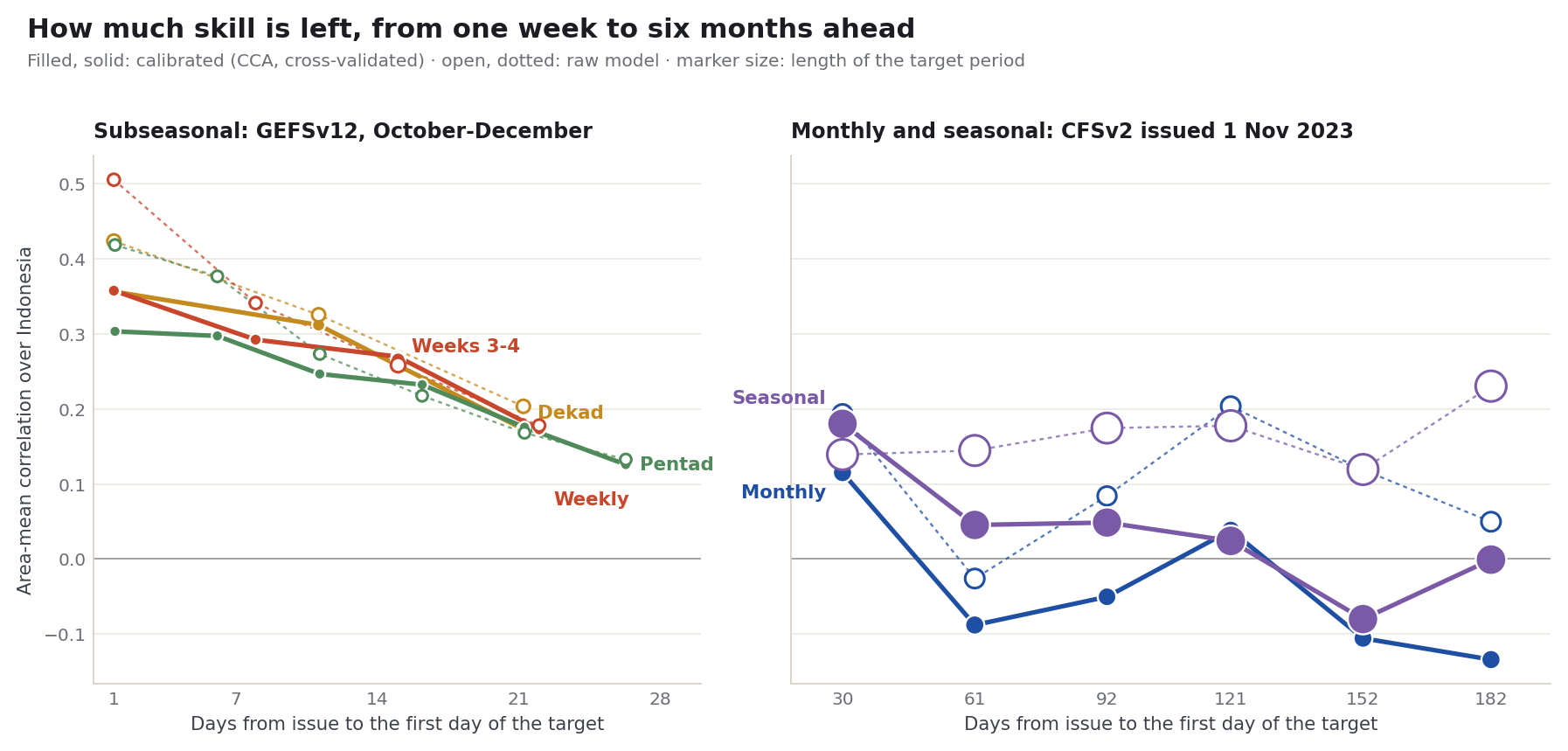
For the subseasonal cases the calibrated area-mean correlation falls from 0.30 to 0.36 for targets starting the day after issue to 0.13 to 0.17 three to four weeks ahead. For the CFSv2 run issued 1 November 2023, monthly and seasonal correlations are at most 0.18.
Every pixel has its own skill
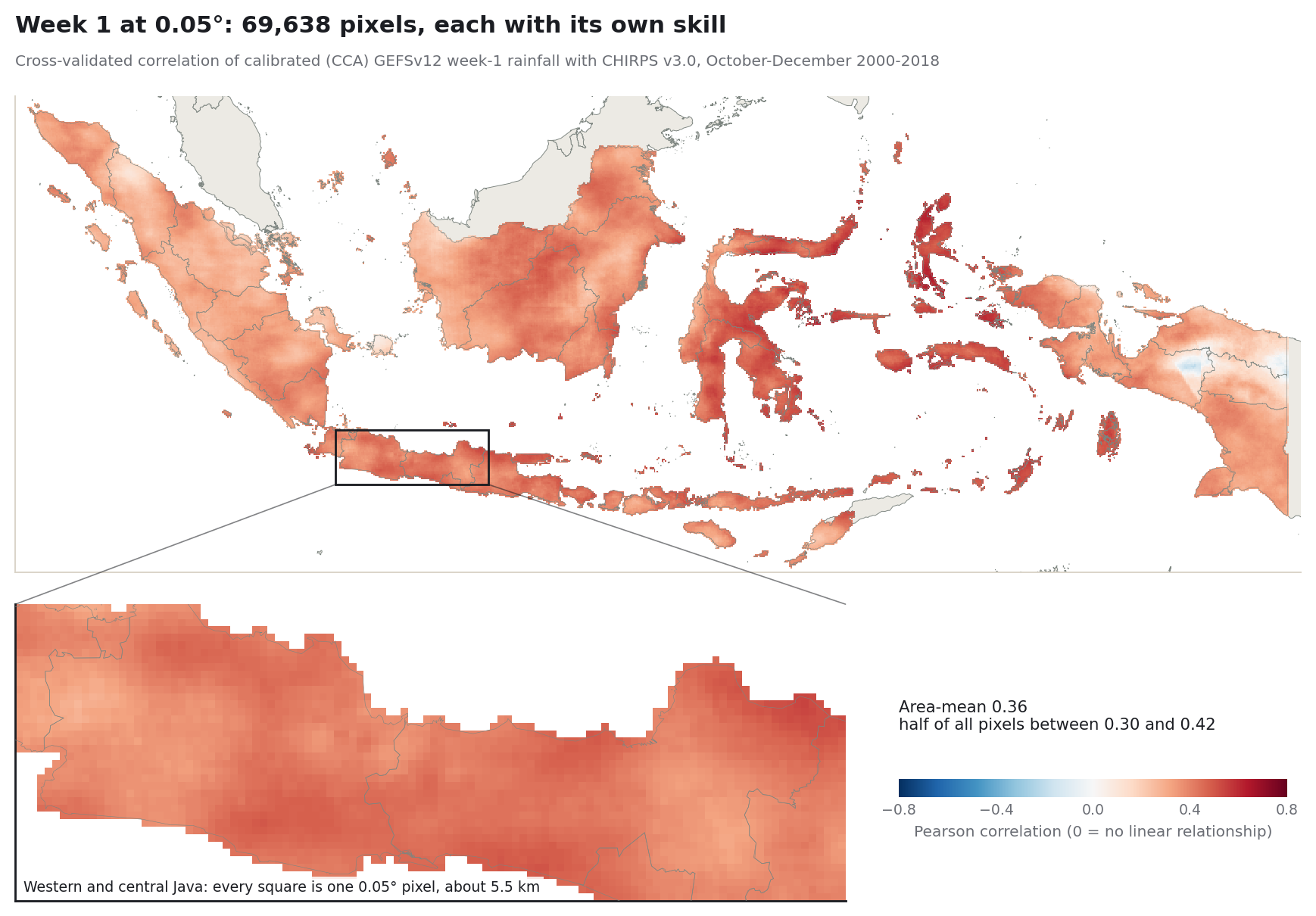
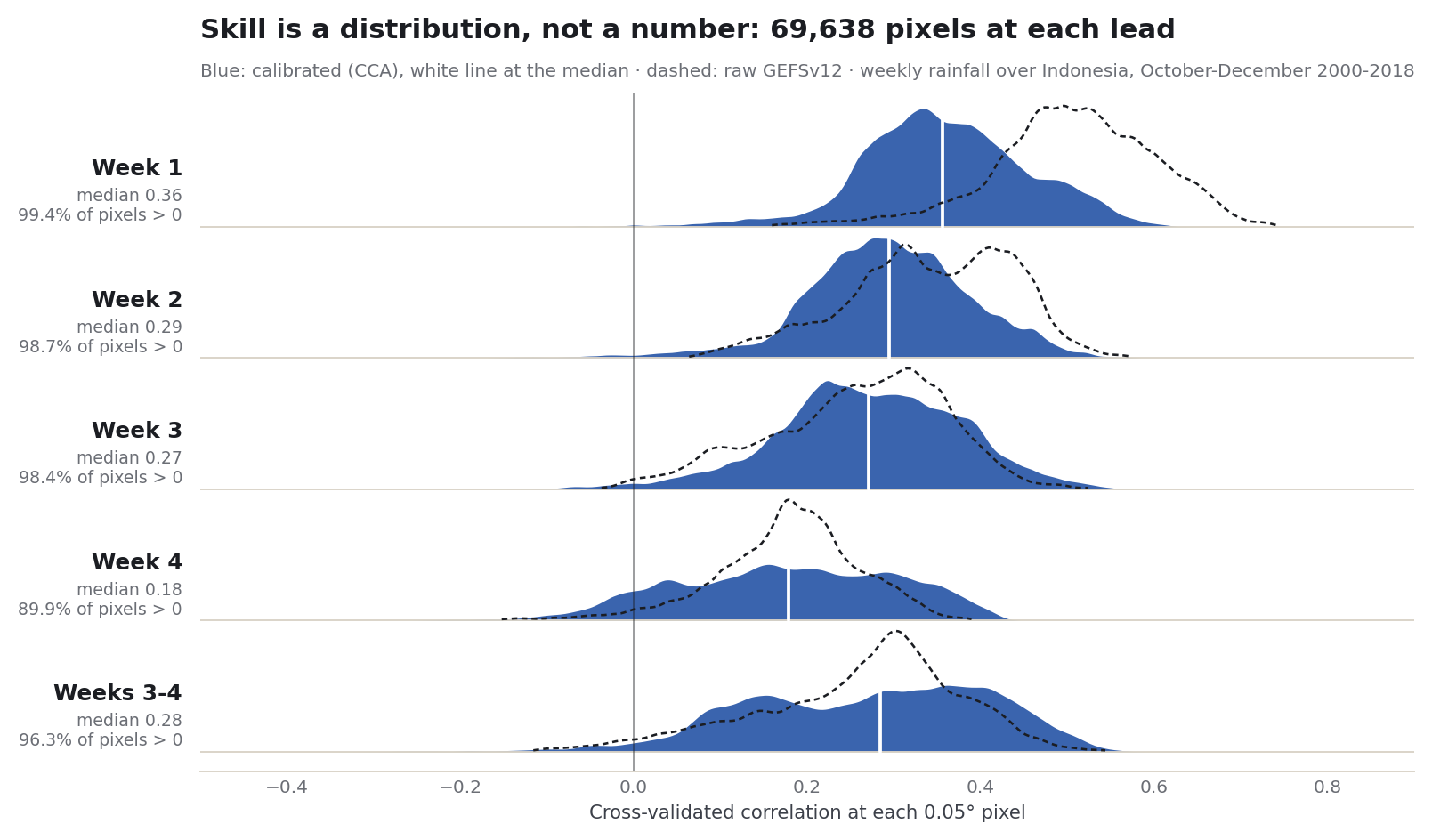
The lead-time cases keep the native 0.05 degree grid, so skill is reported per pixel and not only as an area mean.
Reproducible by design
- Stories and notebooks in pairs. Each case has a readable story and the executed notebook behind it.
- Outputs kept. Scores, comparisons and maps are saved as NetCDF, CSV and JSON, with downloadable kits per case study.
- Frozen research benchmarks. Seven experiments, each with its outputs, a README and manifests listing every file’s SHA-256 hash.
- Three levels of running it. Re-run the saved-results analysis, fit models in the tested PyCPT 2.10.4 environment, or download new data.
What it does not claim
All cases are retrospective learning examples. Their results do not establish operational forecast skill or probability reliability, and no significance tests are claimed.